Space debris
Roughly 40,000 tracked objects circle Earth, and only a quarter of them still work. Here is the whole problem, from definition to cleanup.
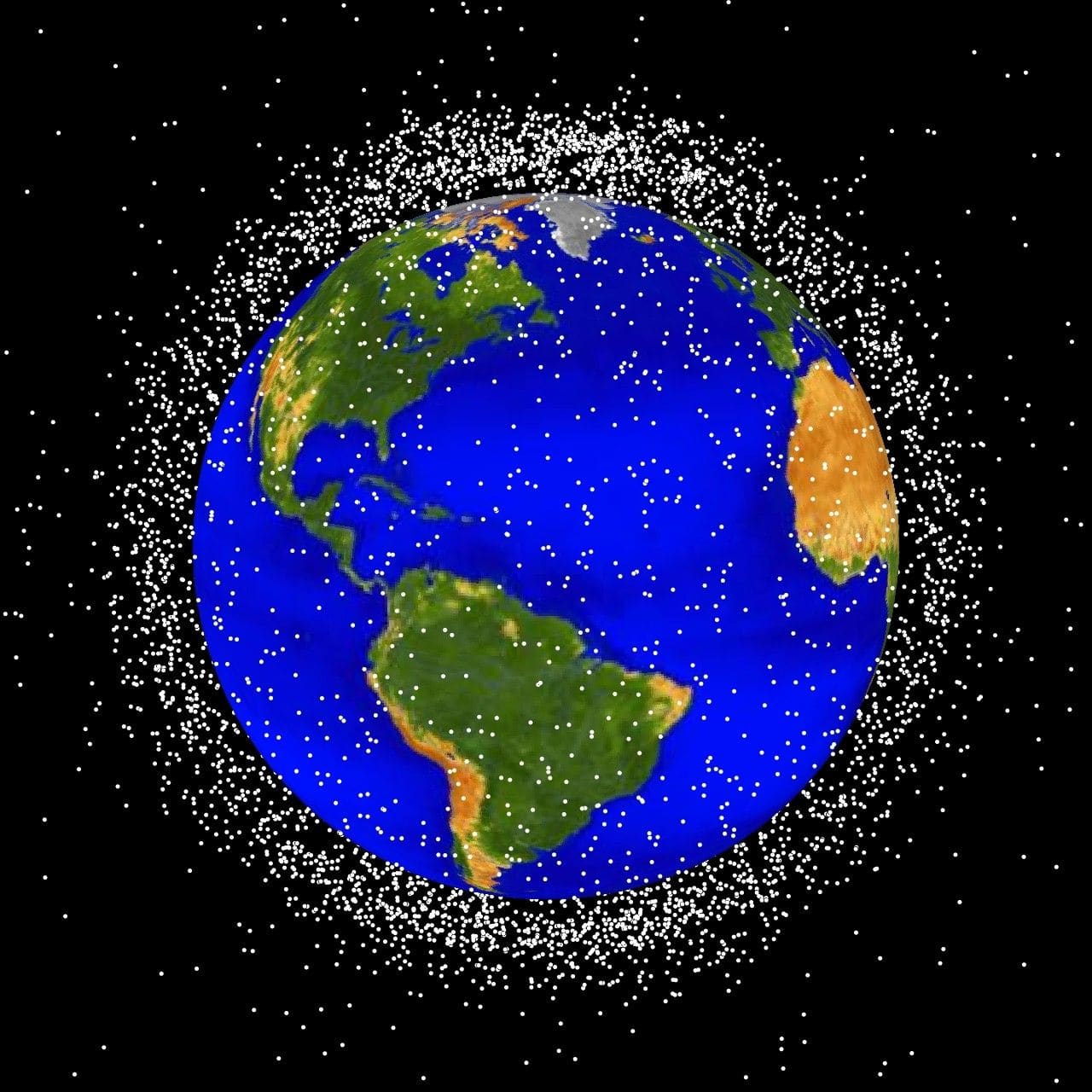
Space debris, also called space junk, is the collection of dead satellites, spent rocket stages, and shattered fragments that orbit Earth with no working purpose. Space surveillance networks now track roughly 40,000 of these objects larger than 10 cm across, and only about 11,000 of them are working spacecraft. The rest is wreckage. It travels at thousands of meters per second, it does not slow down on its own at most altitudes, and it turns a region humanity depends on into a shooting gallery. This page maps the whole problem: what the debris is, how much of it exists, why it threatens the satellites we rely on, how ground stations keep watch, and what cleanup looks like.
What space debris is
Space debris is any human-made object in orbit that no longer serves a function. The catalogue runs from the obvious to the microscopic.
At the large end sit whole dead satellites. A spacecraft reaches the end of its working life, loses power or propellant, and keeps orbiting as a multi-ton hazard. Spent rocket upper stages fall in the same category. After a launch delivers its payload, the final stage often stays in orbit, sometimes with leftover fuel that can explode years later.
The middle of the population is fragments. When two objects collide, or when a fuel tank ruptures, the parent object breaks into hundreds or thousands of pieces. Each fragment becomes its own tracked hazard. ESA recorded more than 3,000 new trackable objects from fragmentation events in 2024 alone.
At the small end are the pieces no telescope can follow: flecks of paint, frozen coolant droplets, slivers of aluminum, and solid-rocket exhaust particles. They are too small to catalogue and large enough to punch through a spacecraft wall. To learn more about the everyday definition and where it all comes from, see our guide on what space junk is.
How much is in orbit
The tracked catalogue and the true population are two different numbers, and the gap between them is the heart of the problem.
Ground-based radar and optical sensors reliably follow objects larger than about 10 cm. That gives the roughly 40,000-object figure in ESA’s 2025 environment report. Models tell a larger story. ESA estimates more than 1.2 million objects larger than 1 cm, and the count climbs past 100 million once you include everything down to 1 mm, a figure NASA’s Orbital Debris Program Office reports as well.
Size does not map to harm the way intuition suggests. A 1 cm fragment is too small to track individually and carries enough energy to disable a satellite. NASA estimates around 500,000 objects in the 1 cm to 10 cm range, the band that is both untrackable and destructive. The total mass now in orbit runs past 9,000 metric tons.
Most of this material sits in low Earth orbit, within 2,000 km of the surface, and concentrates in a shell near 750 to 1,000 km altitude. That band overlaps the orbits used for Earth observation, weather, and communications, which is why crowding there worries operators most.
Why it is dangerous
The danger comes from speed, not size. Debris in low Earth orbit travels around 7 to 8 km/s. When two objects on crossing paths meet, the closing speed averages about 10 km/s and can reach 15 km/s. That is more than ten times the muzzle velocity of a rifle.
At those speeds, kinetic energy scales brutally. A 1 cm aluminum sphere striking a satellite delivers roughly the energy of a small car at highway speed compressed into a point smaller than a marble. A 10 cm object can shatter an entire spacecraft and multiply the debris field in an instant.
The International Space Station shows the daily reality of this. Its modules carry shielding, its windows have been chipped by paint flecks, and it has maneuvered dozens of times over its lifetime to dodge tracked objects. Every dodge costs propellant and interrupts science.
The deeper worry is feedback. Each collision creates fragments, each fragment raises the odds of the next collision, and a crowded orbit can start generating debris faster than the atmosphere clears it. That runaway scenario is Kessler syndrome, named for the NASA scientist who described it in 1978.
How it is tracked
Keeping the catalogue current is a full-time global effort. The United States Space Surveillance Network, operated by the Space Force, anchors the work with a worldwide chain of radar and optical telescopes. The public interface to much of that data is Space-Track. ESA runs its own network and its DISCOSweb portal.
Two sensor types split the job by altitude. Radar works best on low-orbit objects, bouncing signals off debris a few hundred kilometers up and clocking range and speed directly. Optical telescopes handle higher orbits, spotting sunlit objects against the night sky, which is how most geostationary junk gets logged.
Tracking does more than count. Analysts propagate each object’s orbit forward and screen for conjunctions, the close passes where two objects might collide. When the collision probability crosses a threshold, operators get a warning and can plan an avoidance maneuver. The system is imperfect. Orbits drift with atmospheric drag and solar activity, so predictions carry uncertainty, and objects below 10 cm slip through entirely. Our page on space debris tracking breaks down the sensors and the math.
How orbit gets cleaned up
There are two lines of defense: stop making new debris, and remove what is already there.
Prevention runs through mitigation rules. For years the standard asked operators to clear low-orbit spacecraft within 25 years of mission end. In 2022 the U.S. Federal Communications Commission tightened that to five years for satellites operating at or below 2,000 km, and the rule took effect on 29 September 2024. Shorter deadlines mean dead satellites spend less time as hazards before atmospheric drag pulls them down. Design changes help too: venting leftover propellant so old stages cannot explode, and building spacecraft that can steer themselves to a controlled reentry.
Removal is the harder half, because nothing in orbit was built to be caught. Two missions show the state of the art. Astroscale’s ADRAS-J launched in February 2024 and approached a spent Japanese H-IIA rocket upper stage, closing to within 15 meters and photographing the tumbling target to prove that a chaser can safely inspect real debris. ESA’s ClearSpace-1 aims to go further and capture a leftover Vega launch adapter with a robotic system, then drag it down to burn up in the atmosphere. Recovered hardware also teaches engineers how objects survive reentry, a subject we cover in our archive of recovered debris.
Kessler syndrome
Kessler syndrome is the tipping point the whole field works to avoid. NASA scientist Donald Kessler and colleague Burton Cour-Palais laid it out in a 1978 paper, arguing that once debris density in a given orbit passes a threshold, collisions become self-sustaining. Fragments beget collisions, collisions beget fragments, and the belt keeps growing on its own.
The 2009 Iridium-Cosmos crash and the 2007 Chinese anti-satellite test each dumped thousands of fragments into the most crowded altitudes, and researchers watch those shells closely for signs the cascade has begun. The consensus is that we are not in a runaway state today, but the margin is thinning. For the full mechanics and the numbers behind the threshold, read our dedicated explainer on Kessler syndrome.
Space debris is not a distant abstraction. It shapes how satellites are designed, insured, flown, and retired, and it occasionally comes home. When a dead spacecraft finally gives in to drag, it becomes a satellite falling to Earth, the one moment when orbital junk crosses back into our sky.
Sources
Frequently asked questions
How much space debris is in orbit right now?
Space surveillance networks track about 40,000 objects larger than 10 cm. ESA's models put the count above 1.2 million once you include everything larger than 1 cm, and past 100 million once you count fragments down to a millimeter.
How fast does space junk travel?
Debris in low Earth orbit moves at roughly 7 to 8 km/s. A collision brings two objects together at an average of about 10 km/s, so even a paint fleck carries the punch of a rifle round.
Has space debris ever hit a working satellite?
Yes. In 2009 the active Iridium 33 satellite ran into the defunct Cosmos 2251 at about 789 km altitude, producing more than 2,300 trackable fragments that still circle Earth.
Can space debris fall on people?
Intact rocket bodies and satellites reenter more than three times a day on average. Most burns up or lands in ocean. Injuries are close to unheard of, though surviving pieces do reach the ground.
What is being done to clean up space?
Operators now face tighter disposal deadlines, and removal missions are flying. Astroscale's ADRAS-J closed to within 15 meters of a spent rocket stage in 2024, and ESA's ClearSpace-1 aims to capture and deorbit a launch adapter later this decade.
What is Kessler syndrome?
It is a chain reaction. Enough collisions in a crowded orbit create fragments that trigger more collisions, and the debris population feeds itself even if launches stop.