What happens during atmospheric reentry
From the first bite of air to the final impact, here is how a spacecraft goes from orbital speed to a slow fall through thick air.
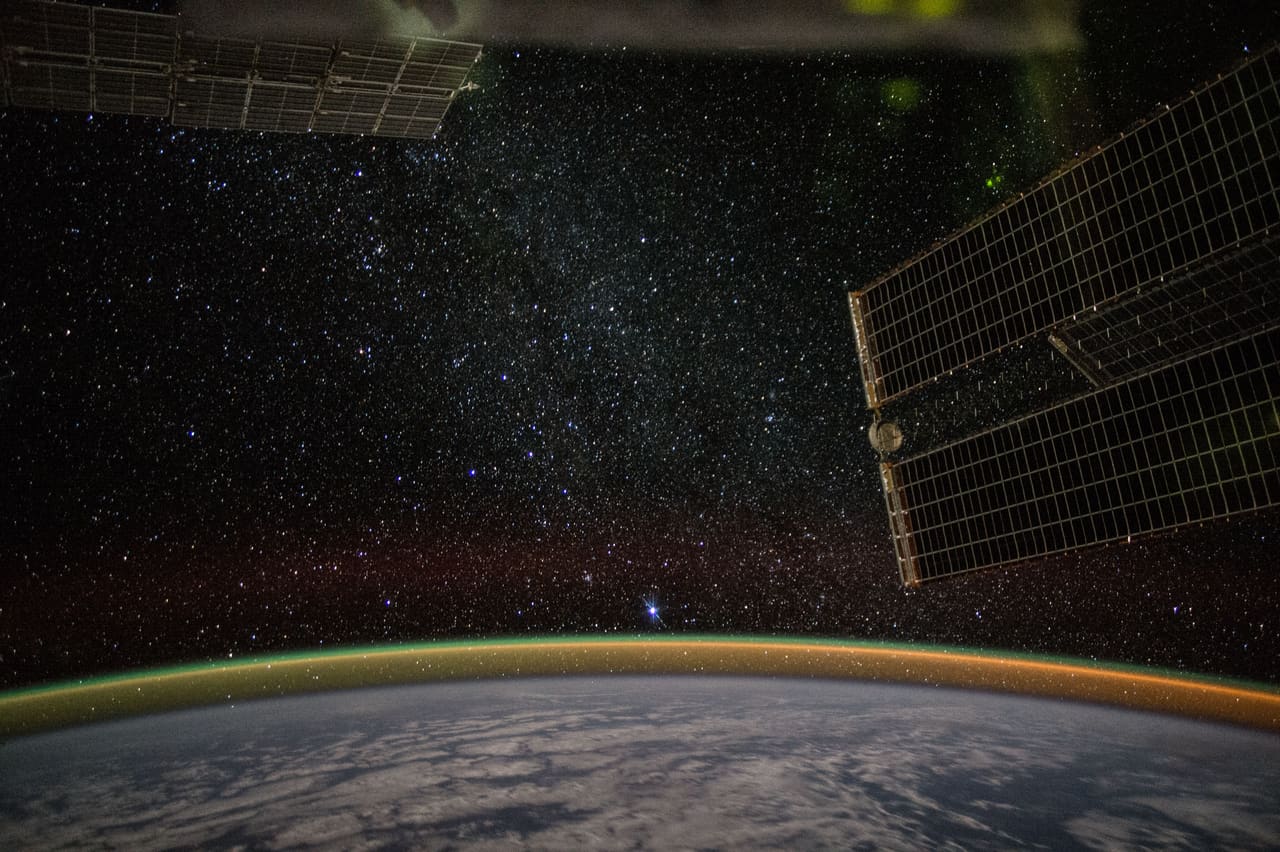
Understanding what happens during atmospheric reentry means following a spacecraft through one of the most violent transitions in physics: the change from orbital speed to a slow fall through thick air. An object in low orbit travels near 28,000 km/h. To reach the ground it has to shed almost all of that speed, and the atmosphere does the work by turning motion into heat, light, and force. Most spacecraft do not survive the process intact. The parts that do arrive at the surface tell a consistent story about which materials last and which do not. This page walks through the sequence from the first bite of air to the final impact.
The reentry sequence
Reentry starts long before the fireworks. A satellite low enough to feel faint atmospheric drag loses a little energy on every orbit. Its path slowly circularizes and lowers, month after month, until it reaches the reentry interface near 120 km. This altitude is the accepted boundary where drag stops being a nuisance and becomes the dominant force acting on the object.
Below 120 km the air thickens fast, and drag rises with it. The object, still moving at close to orbital speed, meets enough resistance to heat up sharply and begin tearing apart. Solar panels, antennas, and thermal blankets go first, ripped away by the airflow. The main body tumbles and glows as its surface temperature climbs past 1,600 degrees Celsius. Around 80 km the structure typically fails and breaks into pieces. ESA’s ERS-2 satellite reached that fragmentation point at roughly 80 km during its 2024 return. From there, each fragment follows its own path down, and the fast, bright phase of the reentry lasts only a few minutes.
For the broader picture of how these events fit into daily orbital traffic, see our overview of a satellite falling to Earth, which covers how often the sequence plays out.
Why objects heat up and break apart
The heat of reentry is often blamed on friction, but that is only part of the story. The larger source is compression. When an object plows into the atmosphere faster than the air can move out of the way, it stacks that air into a dense, superheated shock layer just ahead of its leading surface. Temperatures in that layer soar, and heat pours into the object from the front.
This is why blunt shapes were chosen for crewed capsules: a rounded surface pushes the shock layer away from the vehicle, so more heat stays in the air and less reaches the structure. A random piece of tumbling space hardware has no such protection. It presents whatever face happens to be forward, heats unevenly, and comes under enormous aerodynamic stress at the same time. The combination of thermal load and mechanical force is what pulls the structure apart. Joints weaken, panels peel, and the body separates into fragments that each decelerate on their own. Tracking those fragments is a discipline of its own, which we cover under space debris tracking.
What burns up and what survives
Not everything that comes down burns up, and the difference comes down to materials. Aluminum, which makes up much of a typical satellite’s structure, has a relatively low melting point and tends to demise, meaning it melts and vaporizes, fairly high in the atmosphere. NASA notes that low-melting-point materials break down at higher altitudes than parts built from titanium, stainless steel, beryllium, or carbon composites.
Those heat-resistant parts are the survivors. Titanium fuel tanks, stainless steel pressure vessels, engine components, and dense metal fittings routinely reach the ground. They are also the pieces most often recovered after a reentry, because they are built to hold pressure or withstand engine heat and so shrug off the reentry environment. The Aerospace Corporation estimates that 10 to 40 percent of a satellite’s mass can survive to impact, with the exact figure set by how much of the spacecraft is made from tough, high-melting materials.
Once a surviving fragment slows below orbital speed, it stops generating reentry heat and simply falls. Air resistance and gravity settle it into a terminal descent, and it strikes the ground at something between 50 and 200 km/h. Some small dense pieces arrive with under 15 joules of energy, a level NASA identifies as very unlikely to cause human casualty. That is why a surviving titanium sphere can land in a field and leave little more than a dent.
Controlled vs uncontrolled reentry
Every reentry falls into one of two categories, and the distinction shapes both risk and predictability.
A controlled reentry uses onboard propulsion to command the descent. The operator fires thrusters to lower the orbit on a chosen pass and steer the object toward a target zone, almost always a remote patch of ocean. This lets planners keep surviving debris away from people and set the timing to within minutes. Large, dense spacecraft that would produce heavy fragments are the prime candidates for controlled disposal, because leaving them to chance carries more risk.
An uncontrolled reentry has no such steering. The object is dead, out of fuel, or never designed to maneuver, so atmospheric drag alone decides when and where it comes down. ERS-2 is a clear example: ESA emptied its fuel years earlier to reduce explosion risk, then let drag do the rest. The descent took years to unfold and its final hours were still uncertain. Uncontrolled returns are common for older hardware and spent rocket stages, and they are the reason reentry forecasts carry wide margins.
Predicting where debris lands
Forecasting an impact point is genuinely hard, and the reason is drag sensitivity. The density of the upper atmosphere changes with solar activity, day and night, and season. A small shift in that density changes how fast an object slows, which moves its reentry point by thousands of kilometers. Because the object circles the planet roughly every 90 minutes, an error of even a few minutes in the predicted reentry time translates into a ground-track error spanning continents.
That is why early predictions for an uncontrolled object often list a window covering much of the globe, narrowing only as the final orbits play out. Even in the last hours, forecasters usually give a track rather than a pinpoint. Controlled reentries avoid this problem by design, aiming for the same destination every time. That destination is Point Nemo in the South Pacific, the oceanic point of inaccessibility, sitting more than 2,600 km from the nearest land. Retired stations including Russia’s Mir have been steered there, and it is the planned graveyard for the International Space Station. The plan to bring down that station under control is its own major undertaking, which we detail in our guide to the ISS deorbit.
Reentry, then, is neither random destruction nor a clean disappearance. It is a physical filter. Speed and heat strip away most of a spacecraft, materials decide what lasts, and steering decides where the survivors land.
Sources
Frequently asked questions
What happens during atmospheric reentry?
An object crosses the reentry interface near 120 km, where air becomes thick enough that drag dominates its motion. Friction and compression heat the surface past 1,600 degrees Celsius, stripping away panels and antennas and breaking the main body apart around 80 km. Light materials vaporize while dense, heat-resistant parts survive and fall to the surface.
Why do objects heat up during reentry?
The heat comes mainly from compressing the air ahead of the object, not from surface friction alone. Traveling at orbital speed near 28,000 km/h, the object slams into air faster than it can move aside, forming a superheated shock layer that transfers energy into the surface. Slowing from that speed dumps enormous kinetic energy as heat.
What parts of a satellite survive reentry?
Components made of high-melting-point materials survive most reliably: titanium tanks, stainless steel pressure vessels, and dense metal fittings. Aluminum structures usually melt and demise higher in the atmosphere. Overall, 10 to 40 percent of a satellite's mass can reach the ground depending on its construction.
How fast does surviving debris hit the ground?
Once the object slows below orbital speed, surviving fragments fall under gravity and air resistance. Typical impact speeds run from about 50 to 200 km/h. Some small, dense pieces arrive with under 15 joules of energy, below the level where human injury becomes likely.
What is the difference between controlled and uncontrolled reentry?
A controlled reentry uses thrusters to steer the descent toward a chosen area, usually the empty South Pacific around Point Nemo. An uncontrolled reentry has no steering, so atmospheric drag and solar activity decide the timing and location. Uncontrolled returns are far harder to predict.
Can we predict where debris will land?
Roughly, and better as the moment nears. Early forecasts carry large uncertainty because a small change in atmospheric drag shifts the reentry point by thousands of kilometers. Even hours ahead, predictions often span a wide ground track, which is why exact impact points are rarely known in advance.