The final days of Mir
On 23 March 2001, controllers steered 130 tonnes of space station into the South Pacific. It set the template for every large deorbit since.
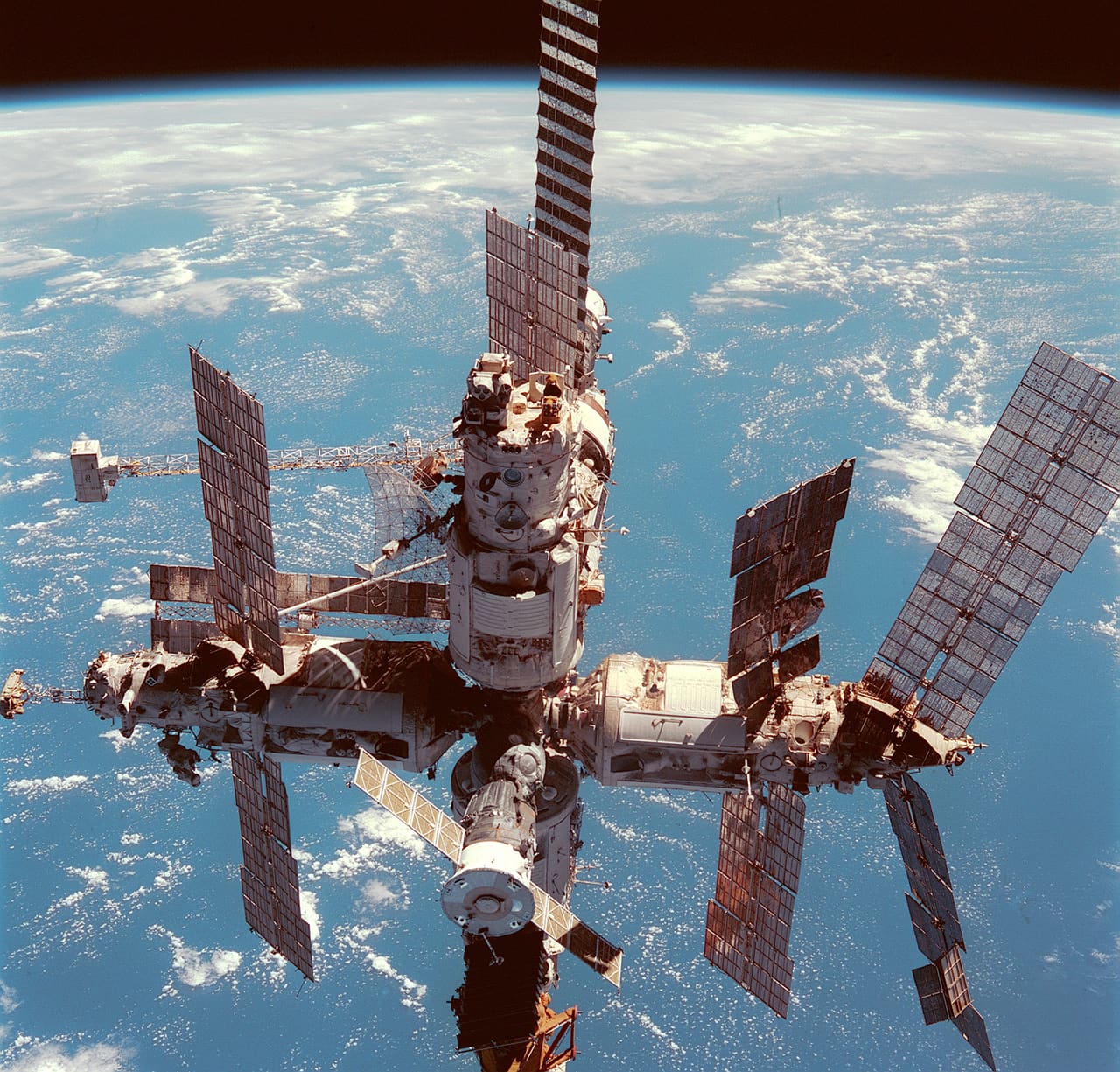
On 23 March 2001, Russian flight controllers guided the Mir space station out of orbit and dropped it into the South Pacific. The operation ended 15 years of flight and closed the era of the first modular, semi-permanent home in low Earth orbit. It also set the template for how the world brings a heavy station down without putting anyone on the ground at risk.
Why Mir was deorbited
Mir launched its base block on 19 February 1986. Over the next decade, ground crews added five research modules, growing the complex to about 130 tonnes and roughly 350 cubic meters of pressurized volume. Across its life, 104 people from 13 countries lived and worked aboard. The station flew 86,331 orbits and traveled some 3.6 billion kilometers.
By 2000, the case for keeping Mir aloft had collapsed. The station was three times past its design life. Systems failed more often, repairs drained money, and Russia had committed its human spaceflight budget to the International Space Station. The last resident crew departed on 16 June 2000, leaving Mir empty and slowly losing altitude.
An empty 130-tonne station is a problem that grows worse with time. Atmospheric drag pulls a dead spacecraft down on its own schedule, and no one can steer where the wreckage lands. Roughly 20 to 40 tonnes of Mir would survive the heat of reentry. Left alone, those fragments could fall anywhere along the station’s ground track, which passed over populated regions between 51.6 degrees north and south.
Space history offered a warning. In February 1991, the Soviet station Salyut 7, still joined to the Kosmos 1686 module, came down uncontrolled after solar activity thickened the upper atmosphere and sped its decay. The 40-tonne complex scattered debris across Chile and Argentina, some of it near the town of Capitán Bermúdez. Mir was three times heavier. Russia chose a controlled deorbit to make sure the wreckage went into the ocean, not over a city.
The deorbit sequence, step by step
The tool for the job was a cargo ship. Progress M1-5 launched from Baikonur on 24 January 2001 and docked to Mir’s Kvant-1 module on 27 January. Engineers had stripped its cargo role and loaded it with 2,678 kg of propellant, more than a standard Progress carries. Its single purpose was to push Mir down. Controllers nicknamed it the “Hearse.”
The station spent March drifting lower. On 1 March it orbited near 264 km. Controllers let drag do the early work, then took over on 23 March with three braking burns.
The first burn started at 00:32 GMT. Progress fired its docking and attitude thrusters for about 21 minutes, a gentle push that lowered Mir’s low point and left the station in an orbit of roughly 188 by 219 km. About 90 minutes later, on the next pass, the second burn ran for 24 minutes and dropped the perigee to near 158 km. Mir was now skimming the edge of the sensible atmosphere.
Controllers let the station coast through two more orbits, checking its path against the target zone. The third and final burn began at 05:08 GMT. This time Progress used its main rendezvous engine along with the thrusters, running for a little over 22 minutes and burning to fuel depletion. That last shove committed Mir to reentry.
Mir crossed the 100 km line at 05:44 GMT. Near 90 km, friction heated the hull enough to wrap the station in glowing plasma. Solar arrays tore away first, then modules broke free and shattered. The main structure came apart over the next few minutes, and the last pieces splashed down around 06:00 GMT.
Where Mir came down
The target was a wide, empty stretch of the South Pacific east of New Zealand, one of the most remote patches of ocean on Earth. Mir’s fiery breakup passed over the region near Fiji, where people on the ground and in aircraft reported a train of bright fragments crossing the dawn sky.
Surviving debris fell along a track centered near 40 degrees south, 160 degrees west. The fragments spread across a corridor roughly 1,500 km long and 100 km wide. Russian and international trackers had predicted a much larger possible footprint, up to several thousand kilometers long. The tight, steep final burn pulled the actual scatter well inside that zone. No fragment reached land, and no one was hurt.
ESA, which watched the reentry closely, had framed the risk plainly beforehand. Most of Mir would burn up as any reentering object does, and the pieces that reached the surface would strike the water with an impact like a small aircraft ditching. That is what happened.
What Mir taught us about deorbiting big stations
Mir was the heaviest object ever brought down under control, and the operation confirmed several ideas that now guide every large deorbit.
The first lesson is propellant margin. A controlled deorbit needs enough fuel to place the final burn precisely and to fight through the buffeting of the upper atmosphere. Progress M1-5 carried far more than a routine resupply load, and controllers still ran it to depletion. Underfueling a deorbit invites a shallow, drawn-out descent that smears debris across a long, poorly predicted track.
The second lesson is entry angle. A steep final burn shortens the debris footprint and tightens the impact zone. Mir’s spread stayed inside its predicted corridor because that last 22-minute burn drove the station down hard rather than letting it graze the atmosphere over many passes.
The third lesson is aim point. Planners chose the South Pacific because it holds the largest expanse of ocean far from shipping lanes and coasts. That same region, centered on the oceanic pole of inaccessibility known as Point Nemo, has served as the resting place for hundreds of spent spacecraft. It is the safest place on the planet to drop wreckage.
These lessons carry straight into the largest deorbit still to come. The International Space Station masses about 420 tonnes, more than three times Mir. Drag alone cannot bring it down safely, and no cargo ship holds enough fuel to steer it. NASA has contracted a purpose-built US Deorbit Vehicle to dock with the station near the end of the decade and steer it into the atmosphere over the same empty South Pacific waters. The plan rests on the physics Mir demonstrated: reserve fuel, a steep committed burn, and an ocean aim point. For the full picture of how that far larger operation will work, see our guide to the ISS deorbit.
Mir’s fall was an ending, but it was also a proof. A station too old to fly does not have to fall at random. With the right vehicle and a careful burn, it can be aimed at the water and taken down on human terms.
Sources
Frequently asked questions
When and where did Mir reenter?
Mir entered the atmosphere at 05:44 GMT on 23 March 2001 and broke apart over the South Pacific. The last fragments fell into the ocean around 06:00 GMT, near 40 degrees south and 160 degrees west, east of New Zealand. Observers in Fiji watched the fireball cross the sky.
What deorbited Mir?
A modified cargo ship, Progress M1-5, docked to Mir carrying 2,678 kg of propellant. It fired three times on 23 March 2001 to drop the station into the atmosphere.
How big was Mir?
Mir massed about 130 tonnes across six pressurized modules. It was the largest human-made object deorbited under control at that time.
Did any debris reach land?
No. Fragments that survived the fire of reentry fell along a track in the open South Pacific, far from inhabited coasts.
How does Mir relate to the ISS deorbit?
Mir proved that flight controllers can steer a large station into a chosen ocean zone. NASA will apply the same principle to the ISS, using a dedicated deorbit vehicle to aim for the same remote South Pacific waters.